North Korea 🇰🇵
Democratic People's Republic of Korea

The flag of North Korea is composed of three horizontal bands — a large central white-edged red band, and a blue band above and beneath the red band. On the hoist side of the red band is a red five-pointed star within a white circle.
Location
Quick Facts
Alpha 2
KPAlpha 3
PRKNumber
408TLD
.kpCapital
PyongyangPopulation
25,778,815Area
120,538 km²Languages
Currencies
Drives on
RightWeek starts
MondayTimezones
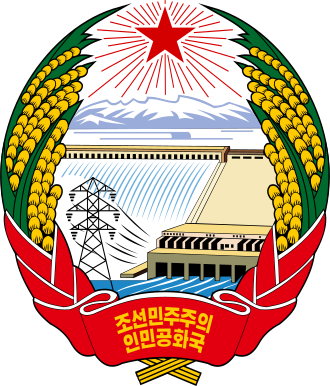
UTC+09:00Coat of Arms
What is the Flag of North Korea?
The national flag of North Korea is officially known as the “Ramhongsaek Konghwagukgi”, or “Red Flag Flying in the Blue Sky of Korea”. It is a horizontal tricolor of red, blue and white with a central red disk. The red disk symbolizes Communism and socialism, and is the same symbol found on the flag of the Korean Workers' Party.
What Does the North Korea Flag Look Like?
The North Korea flag is composed of three horizontal stripes of blue, white, and red. The blue stripe is on top, the white stripe is in the middle, and the red stripe is on the bottom. The central red disk is placed in the middle of the white stripe, and has a proportion of two-thirds of the white stripe's width. The disk is bordered in white, and contains a five-pointed star in black.
What is the North Korea Flag Called?
The North Korea flag is officially known as “Ramhongsaek Konghwagukgi”, or “Red Flag Flying in the Blue Sky of Korea”. It is also known as the “Red Star Flag”.
What Does the North Korea Flag Represent?
The North Korean flag is a symbol of the country’s commitment to Socialism and Communism. The blue stripe represents sovereignty, peace, and friendship, while the white stripe is a symbol of purity and honesty. The red stripe symbolizes the struggle for freedom and the red disk in the middle of the flag is a symbol of Communism and socialism. The five-pointed star in the red disk symbolizes the ideals of the working class. The flag is a symbol of the country’s commitment to the ideals of Communism, Socialism, and the Korean Workers' Party.
Who Created the North Korean Flag?
The North Korean flag is one of the most iconic symbols of the country, and has been since its adoption in 1948. It is the only national flag in the world that features a hammer, sickle and calligraphy brush, which are symbols of the ideology of the country’s ruling party, the Workers’ Party of Korea. The flag was designed by Kim Il-sung, the first leader of the Democratic People’s Republic of Korea (DPRK).
Kim Il-sung was born in 1912 in the then-Japanese-occupied Korea. He was a staunch communist, and was an influential figure in the Korean independence movement. At the end of World War II, Kim Il-sung was chosen as the leader of the Democratic People’s Republic of Korea in 1948. As leader of the newly formed nation, he wanted to create a symbol of unity and strength that would inspire the people of North Korea.
To create the North Korean flag, Kim Il-sung chose three symbols to represent the ideology of the ruling party: the hammer for the industrial workers, the sickle for the agricultural workers, and the calligraphy brush for the intellectuals. He also chose the colours red and blue, which have been used in traditional Korean culture to represent good luck and prosperity.
When it was adopted in 1948, the North Korean flag featured a white circle with a five-pointed red star in the centre. This symbol was chosen to represent the Korean people, and can also be seen in the national emblem of North Korea. In 1992, the North Korean flag was slightly altered to include a blue stripe with the hammer, sickle and calligraphy brush. This stripe was added to represent the unification of all classes of people in North Korea.
The North Korean flag is a unique symbol of the country’s history and ideology, and it is a powerful reminder of the nation’s strength and unity. It was designed by Kim Il-sung with the purpose of inspiring the people of North Korea, and it continues to be a source of national pride.
Bordering Countries


Similar Flags
Flags that share colours with North Korea